
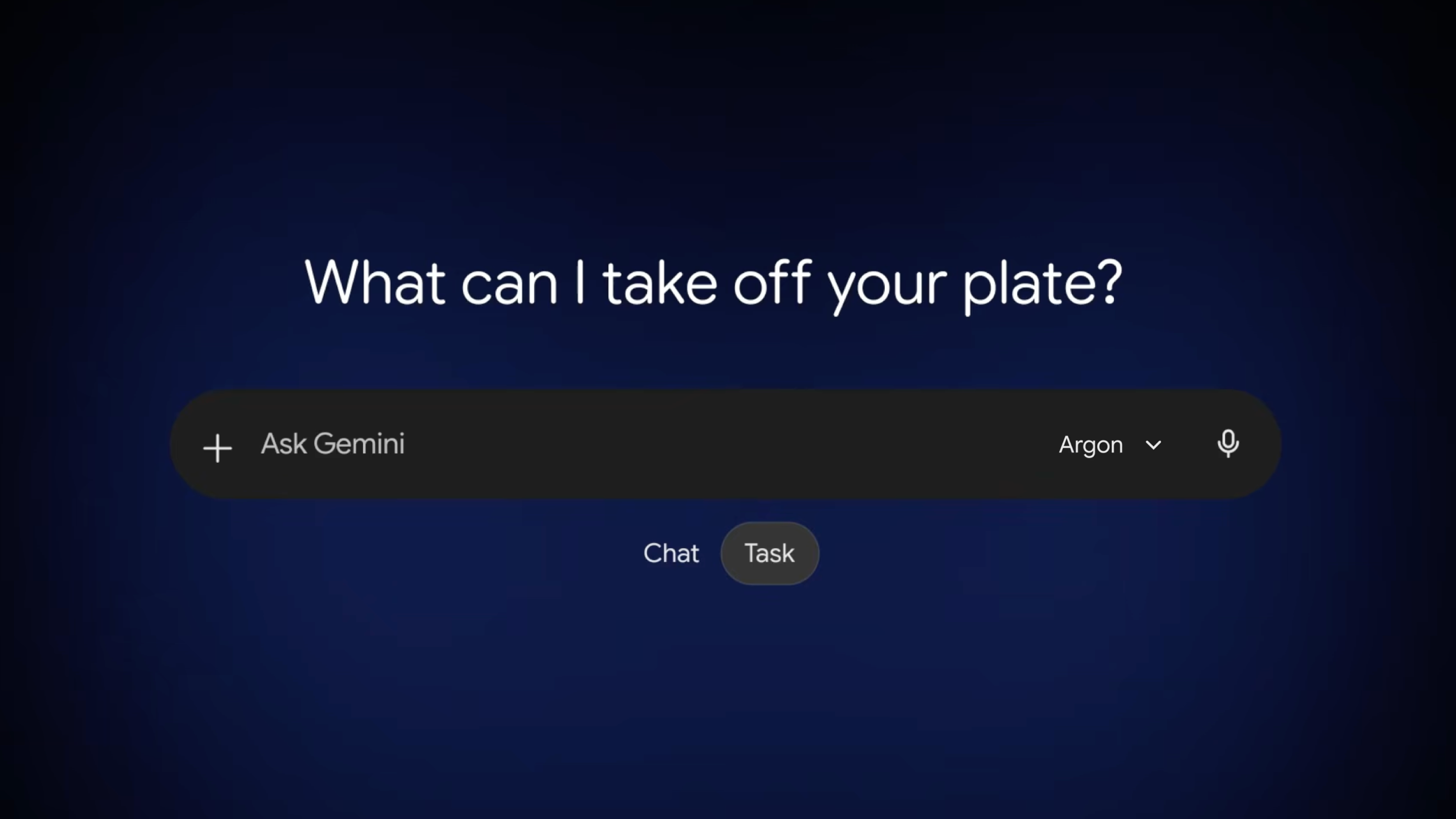
Gemini 4 Argon Is Here — and Gemini Just Got a “Task” Mode
- theDevXpert Team
- October 14, 2026
- No Comments
Featured image: Google, from its October 13, 2026 announcement “Gemini 4 Argon comes to the Gemini app”
Introduction
Two weeks ago, Google’s newest flagship AI model was locked behind an invite-only program for cybersecurity teams. As of yesterday, October 13, 2026, it’s sitting in the model picker of the regular Gemini app, next to a new button that lets Gemini go off and work on something while you do other things. If you pay for Google AI Pro or Ultra, both changes are live on your account right now. If you don’t, neither one is — and Google hasn’t said when, or if, that will change for free users.
Here’s what actually shipped, who gets it, and what it’s realistically useful for today.
What Happened?
Google introduced Gemini 4 Argon on September 30, 2026, as its new frontier model for long, multi-step work: software engineering, legal and financial research, and cybersecurity defense. At launch, it wasn’t available to the public at all. Google rolled it out only to a “set of trusted cyber defenders” through what it calls the Fairwind Program, saying it needed to gather feedback and tighten safety guardrails “before making Argon available to developers, enterprises, and consumers.”
On October 13, Google followed through on two fronts at once. In a post titled “Gemini 4 Argon is now available for developers,” the company opened up the paid tier of the Gemini API, Google AI Studio, and Android Studio to the model, with Google AI Ultra subscribers also able to use it inside Antigravity, Google’s agent-focused coding platform. Separately, in a post aimed at everyday users, Google said Argon is “now available in the Gemini app” for anyone on a Google AI Pro or Ultra plan — the same post that introduced a new “Task” option sitting next to the regular chat box.
The Key Details
Argon’s access is still gated by subscription, not by invitation. That’s the actual news: it moved from “nobody outside a trusted testing group” to “anyone paying for Pro or Ultra.” Free Gemini users are not included, and Google’s own Help Center page listing which models each plan can use hadn’t been updated to even mention Argon as of this writing — a documentation lag we’ve seen before with Google’s AI announcements outrunning its support pages.
The new “Task” mode is a separate, specific feature, not just a label for “using Argon.” Google’s support documentation spells out exactly what it needs:
- You must be 18 or older, signed in with a personal Google Account (not a work or school account)
- A Google AI Pro or Ultra subscription
- “Keep Activity” turned on, and opting in to Google’s “Personal Intelligence” feature
- It only works in the Gemini mobile app, the Mac app, or at gemini.google.com — not yet on other surfaces
- It is not available in the European Economic Area, Nigeria, Switzerland, or the United Kingdom, with no timeline given for when that might change
Once those boxes are checked, you pick “Task” instead of “Chat,” describe a goal instead of a question, and Gemini can work on it using your connected apps, saved skills, and — if you let it — your local Chrome browser or a separate cloud browser it controls on its own. Google’s examples include decluttering an inbox, watching flight and hotel prices against a budget, and pulling research into a finished document, spreadsheet, or slide deck.
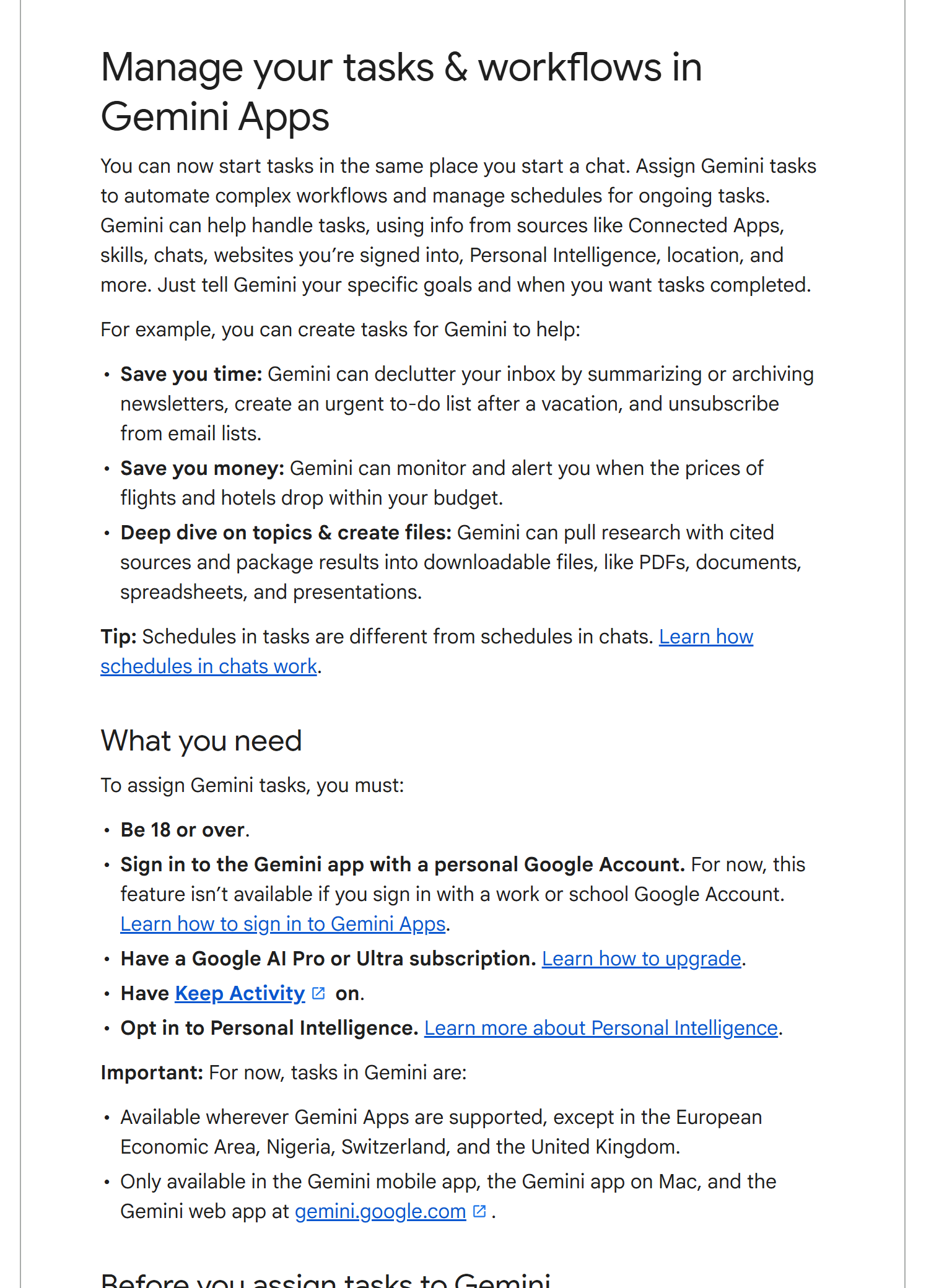
Google’s own Help Center page spelling out exactly who can use Task mode — and where it’s excluded. Source: Google Gemini Apps Help
The same announcement also bundled in two other changes: Google Antigravity’s coding interface is now built directly into the Gemini Mac app, so switching between a normal chat and a coding session doesn’t require a separate program, and Gemini says it now connects to more than 40 apps — Google specifically names Instacart, OpenTable, Adobe, and Shopify — for carrying out tasks that touch services outside Google’s own ecosystem.
On capability, independent reviewers who tested Argon before this wider rollout found a mixed but interesting picture. eesel AI’s review, published October 1 based on Google’s published benchmark tables and pre-release access given to Artificial Analysis, found that Argon posted a notably low 15% hallucination rate on Artificial Analysis’s AA-Omniscience knowledge test — compared to 51% for OpenAI’s GPT-6 Astra. The catch: Argon’s raw accuracy on hard factual questions was actually lower than Astra’s (50% versus 63%); it simply says “I don’t know” far more often instead of guessing. The same review found Argon leading comparable models on Google’s own Vals Index, Harvey’s legal-research benchmark, and Zapier’s AutomationBench, while trailing Claude Opus 5.5 and Claude Sonnet 5.5 specifically on terminal-based coding tasks. Worth stating plainly: those benchmark comparisons are vendor- and reviewer-reported, not something we tested ourselves, and Google’s own launch post reports Argon setting a new score of 77.9% on DeepSWE v1.1, a long-horizon software engineering benchmark.
Pricing, per Google’s own launch post, starts at an introductory $2 per million input tokens and $10 per million output tokens through the API, with cached input priced 95% lower; after the introductory period, standard pricing rises to $4 and $20. Google hasn’t said how long the introductory rate lasts.
Why It Matters
Google has spent the past year trailing OpenAI and Anthropic on headline model releases while leaning on Gemini’s huge consumer install base. Argon’s staged rollout — cyber defenders first, then developers and paying subscribers, with no stated date for free users — suggests Google is treating this launch more cautiously than its past ones, not less. Bundling the model release with a genuinely new interaction mode (Task, instead of just Chat) is also notable: it’s Google’s most direct answer yet to the “AI that works in the background for you” pitch that OpenAI’s dots and Meta’s Muse have been making since September.
What It Means for You
If you’re a Google AI Pro or Ultra subscriber: You can try Task mode today by opening the Gemini app and selecting “Task” instead of “Chat.” Start with something low-stakes and reversible — summarizing a cluttered inbox or pulling together researched notes — rather than anything involving payments or account sign-ins, since Google’s own guidance warns the feature can still make mistakes and recommends you avoid typing sensitive information directly into a task.
If you’re a free Gemini user: Nothing changes for you today. Google has not published a date for when Argon or Task mode might reach free accounts, and given that Google quietly cut free users back to its smaller Flash-Lite model earlier this month, there’s no particular reason to expect that to happen soon.
If you’re in the EU, UK, Switzerland, or Nigeria: Task mode is explicitly excluded from your region right now, regardless of which plan you’re on, and Google hasn’t said why or for how long.
If you’re a developer: Argon is available today through the paid Gemini API tier, Google AI Studio, and Android Studio, with Ultra-subscriber access inside Antigravity. Given the terminal-coding gap reviewers noted against Claude’s latest models, it’s worth testing Argon on your own repository before switching a production coding workflow over to it — a point that applies more broadly whenever a team is weighing a new model against an existing agentic setup.
What Happens Next?
Google has said access will keep expanding to “developers, enterprises, and consumers” but hasn’t committed to a date for free-tier access, for the four excluded regions, or for when introductory API pricing ends. Whether independent benchmark firms get full access to verify Google’s own numbers — rather than relying on the partial pre-release testing Artificial Analysis and others did in early October — is also still an open question.
Final Takeaway
Gemini 4 Argon didn’t go from zero to everyone overnight — it went from a closed pilot for cybersecurity teams to a feature paying Google AI subscribers can try today, with a genuinely new way to hand Gemini a goal instead of a question. If you’re already paying for Pro or Ultra, it’s worth a look. If you’re not, or you’re in one of the excluded regions, this is a preview of where Gemini is headed rather than something you can use yet.
Sources
- Google — “Gemini 4 Argon: our next era of frontier intelligence” (Sept 30, 2026)
- Google — “Gemini 4 Argon comes to the Gemini app” (Oct 13, 2026)
- Google — “Gemini 4 Argon is now available for developers” (Oct 13, 2026)
- Google Gemini Apps Help — “Manage your tasks & workflows in Gemini Apps” (accessed Oct 14, 2026)
- Google Gemini Apps Help — “Changes to Gemini model access and limits” (accessed Oct 14, 2026)
- eesel AI, Rama Adi — “Gemini 4 Argon review: benchmarks, costs, and my verdict” (Oct 1, 2026)