
ChatGPT Ads Are Coming to Your AI Images: What to Know
- theDevXpert Team
- October 7, 2026
- No Comments
Featured image: Official announcement graphic by OpenAI (“Building advertising for the way people use AI”).
OpenAI announced on October 5, 2026 that it is testing a new kind of ad inside ChatGPT: a visual ad format that appears during image generation, not just at the bottom of a text answer. If you’re on the Free or Go plan and you ask ChatGPT to create an image, you may soon see a sponsored image alongside it — something that hasn’t happened before.
This matters because it’s the first time OpenAI is placing ads inside one of ChatGPT’s creative tools rather than below a chat response. It also lands at an interesting moment: OpenAI’s ad business has scaled from zero to roughly $1 billion in annualized revenue in under eight months, while Anthropic has built an entire marketing campaign around keeping Claude ad-free. If you use ChatGPT’s free tier regularly, here’s exactly what’s changing, who sees it, and how to control it.
What Happened?
In a post titled “Building advertising for the way people use AI,” OpenAI said it is introducing a new visual ad format, expanding its measurement tools and advertiser partnerships, and testing new ways to assess “brand suitability” — essentially, keeping ads away from sensitive conversations.
The headline change is the ad format itself. Instead of a text-based sponsored link under a response, the new format shows product images — “product inspiration, product usage, or the experiences [a product] makes possible,” in OpenAI’s words — designed to help people “imagine how products and services could fit into their lives.” OpenAI’s own example shows a grocery brand called “Heirloom Grocery” appearing as a labeled ad beneath an image-generation conversation, with a product photo, a headline (“Fresh ideas for dinner”), and a “Learn more” button.
Testing starts later this month in the United States with an initial group of advertisers. Initially, the format will only appear during image generation in ChatGPT for users on the Free and Go plans. OpenAI says the ads will be clearly labeled and kept visually separate from the image ChatGPT actually generates for you, and that advertising does not influence the answers or images ChatGPT produces.
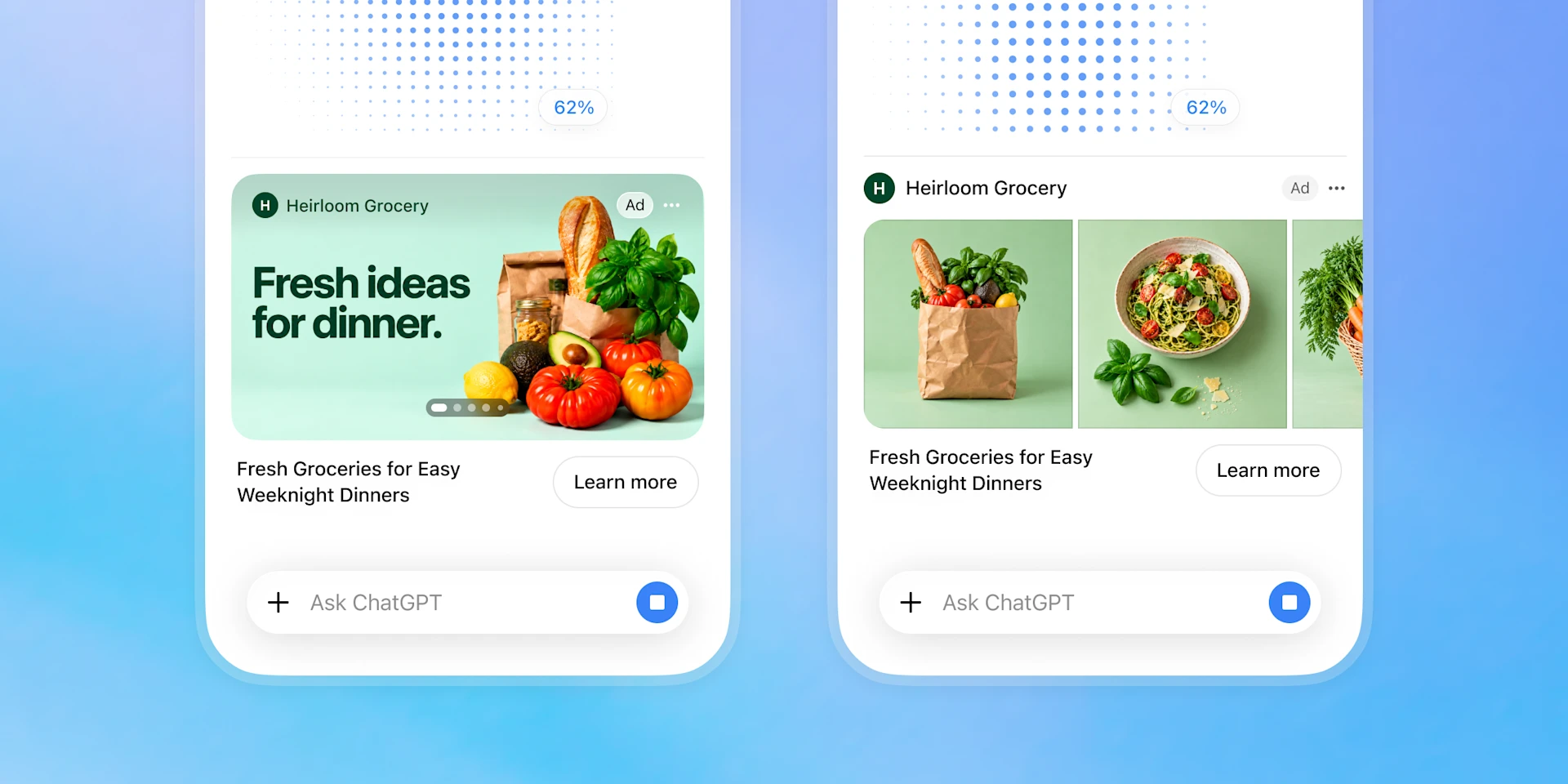
OpenAI’s official example of the new visual ad format inside ChatGPT’s image generation flow. Image: OpenAI.
The Key Details
A few specifics worth knowing, drawn from OpenAI’s announcement and its ads help center:
- Who sees ads at all: Ads can appear for users on the Free and Go plans. Plus, Pro, Business, Enterprise, and Edu accounts do not see ads. OpenAI says it does not show ads to accounts it identifies as belonging to people under 18, based on account signals and age prediction.
- Where ads are currently available: Ad testing began in the US on February 9, 2026, and has since expanded to the UK, Australia, New Zealand, and Canada. The new image-generation format is starting in the US only.
- Ads don’t touch the model’s output: OpenAI says ads run on separate systems from the chat model, and advertisers “have no ability to shape, rank, or alter ChatGPT’s responses.”
- Privacy: OpenAI says it does not share conversations with advertisers and never sells user data. Advertisers receive aggregated performance data, such as views and clicks, not chat content. If ads personalization is enabled, select signals from your broader ChatGPT use — including memory and past chats — can help choose which ad to show. Personalized ads are not currently available in the European Economic Area or Switzerland.
- You can turn personalization off, or turn ads off entirely: In Settings → Ad Controls, you can disable ad personalization, see why you were shown a specific ad, or clear your ads data. Free users can also switch to an “Ads-Free” option, which removes ads but lowers usage limits and — notably — removes access to some tools, including image generation and deep research. In other words, the free way to avoid the new ad format is to give up the feature it appears in.
OpenAI is also expanding how advertisers measure results, with new integrations for customer-data platforms (Hightouch, Tealium, LiveRamp) and attribution partners (AppsFlyer, Triple Whale, Adjust, Branch, and others), plus pilot programs with DoubleVerify and Integral Ad Science to let independent firms evaluate how OpenAI’s brand-safety rules hold up. OpenAI shared early, vendor-reported performance claims from a handful of advertisers — for example, DV Rockerbox attributed a lower cost-per-acquisition for one brand on ChatGPT Ads versus its paid-search benchmark. These are advertiser-supplied figures from early tests, not independently audited results, so treat them as promotional context rather than a general benchmark.
Why It Matters
ChatGPT ads aren’t new — OpenAI first laid out its advertising principles in January 2026 and began testing in February. What’s new is where an ad can appear. Until now, sponsored content sat below a chat response, clearly separated from whatever ChatGPT generated for you. The October update puts a labeled ad directly alongside AI-generated images — arguably the most personal, creative part of the ChatGPT experience for many free users.
It also shows how quickly advertising has become central to OpenAI’s business. The company said in April that its ad pilot crossed $100 million in annualized revenue within six weeks, and by the end of August it had reached roughly $1 billion in annualized run rate — a figure still short of OpenAI’s own $2.5 billion target for the year, but a fast climb for a product that didn’t exist a year ago. OpenAI frames advertising as the way it funds broad, mostly free access to ChatGPT rather than charging everyone a subscription.
That framing puts OpenAI in direct contrast with its two biggest rivals. Anthropic spent its first-ever Super Bowl campaign in February 2026 mocking the idea of ads in AI chat, pledging that Claude will carry no ads or sponsored placements and that its answers won’t be shaped by advertisers — funding itself instead through subscriptions and enterprise contracts. Google, for its part, has said through its VP of global ads that there are “no ads in the Gemini app and no current plans to change that,” though it has separately tested ad formats inside Google Search’s AI Mode. If you’re choosing between assistants partly on this basis, OpenAI is currently the only one of the three actively building out an ads business inside its main chat product.
What It Means for Everyday ChatGPT Users
If you’re on ChatGPT Free or Go in the US, here’s what to actually expect and do:
- You may not see this immediately. OpenAI is testing with “an initial group of advertisers” starting later in October, so the new format will roll out gradually, not to every account at once.
- Check your ad controls now. Go to Settings → Ad Controls to see what’s available on your account, turn off personalization if you’d rather ads be based only on your current conversation, or clear your ads data.
- Know the trade-off if you go ads-free. Switching to the Ads-Free option on the Free plan removes ads, but it also caps your daily messages and removes access to some tools — including image generation itself. If you regularly generate images and don’t want ads, your realistic options are to accept the ads, or upgrade to Plus or Pro.
- Ads won’t show up in sensitive conversations. OpenAI says ads are not eligible to appear near topics like personal health, mental health, or politics, and political advertising isn’t currently allowed on the platform at all.
What It Means for Businesses and Developers
For advertisers, the new format is a shift from text-link-style ads to something closer to a product photo in a social feed, aimed specifically at the moment someone is already asking ChatGPT to generate or imagine something visual. The expanded measurement partnerships (Hightouch, Tealium, LiveRamp, and the attribution/incrementality partners listed above) are aimed at convincing performance-marketing teams that ChatGPT Ads can be measured with the same rigor as search or social advertising. For developers and businesses building on OpenAI’s platform, there’s no direct API or product change here — this is a ChatGPT consumer-product feature, run through OpenAI’s separate Ads Manager at ads.openai.com, not something that touches the API or GPT-6 model behavior.
What Happens Next
A few things worth watching: OpenAI has said in its ads principles that it plans to keep adding ad formats over time, and earlier hiring postings referenced building out video and conversational ad formats as well, so image generation likely won’t be the last ChatGPT feature to carry ads. It’s also worth watching whether the new format expands beyond the US, and whether personalized ads eventually reach the EU and Switzerland, where they’re currently excluded. Finally, Google’s position on Gemini ads has been publicly denied so far, but the company has acknowledged testing ad formats in related products — if OpenAI’s numbers keep climbing, that’s a pressure point to watch.
Final Takeaway
OpenAI isn’t just testing a new ad slot — it’s testing whether people will accept sponsored content inside the part of ChatGPT they use to make things, not just the part they use to ask questions. The ads are labeled, they’re currently US-only and limited to Free and Go accounts, and OpenAI has built in controls to turn personalization off or opt out entirely. But that opt-out currently costs you the very feature the new ads appear in — image generation — which is worth knowing before the test reaches your account.
Sources
- OpenAI — “Building advertising for the way people use AI” (October 5, 2026)
- OpenAI Help Center — “Ads in ChatGPT” FAQ
- OpenAI — “Our approach to advertising and expanding access to ChatGPT” (January 16, 2026)
- Axios — “Anthropic pledges ad-free Claude, with a Super Bowl shot at ChatGPT” (February 4, 2026)
- MacRumors — “Anthropic Promises Claude Will Remain Ad-Free, Mocks ChatGPT Ads in Super Bowl Commercial” (February 4, 2026)
- Dealstreet Asia — “OpenAI says ad business has hit $1b annualised revenue run rate”
- Tom’s Guide — “Google denies report that ads are coming to Gemini following major ChatGPT backlash”