

ChatGPT’s New Virtual Try-On vs Google’s Year-Old Head Start: Which AI Actually Helps You Shop?
- theDevXpert Team
- October 2, 2026
- No Comments
Introduction
On October 1, 2026, OpenAI added two new shopping features to ChatGPT: a virtual try-on tool that shows clothing or accessories on a photo of you, and a Favorites feature that saves products you like to a Library inside the app. It’s a genuinely useful idea — the kind of thing that saves you from guessing whether a dress will actually suit you before you click “buy.”
There’s just one catch: Google has been doing this since May 2025, and it has since pushed further into actually completing the purchase for you. So before you get excited about ChatGPT’s new party trick, it’s worth knowing what you’re comparing it to. Here’s what each one actually does, where they differ, and which is worth your time depending on what you’re shopping for.
Image: OpenAI’s official graphic for ChatGPT Images 2.5, the image-generation model that powers the new try-on feature. OpenAI has not published a dedicated image for the October 1 shopping launch itself. Credit: OpenAI.
What Happened
OpenAI announced the global launch of virtual try-on and Favorites in ChatGPT on Thursday, October 1. According to TechCrunch, a user taps a clothing or accessory listing in ChatGPT’s shopping results, hits the new “Try On” button, and uploads a selfie or full-body photo. ChatGPT then generates an image showing roughly how that item might look on them. You can also upload a screenshot of an item from any website and ask ChatGPT to try it on for you, or describe a style you want and have ChatGPT shop for the pieces to complete it.
Favorites works alongside it: products you like get saved to a Library in the app, alongside your try-on images, so you don’t lose track of them mid-conversation.
Both features run on ChatGPT Images 2.5, the image-generation model OpenAI released on September 8, 2026, which OpenAI says produces more natural lighting and richer textures and “follows editing instructions more reliably across multiple turns,” according to a company statement reported by WWD. OpenAI is explicit that the result is an approximation: a try-on image “does not guarantee fit or size.”
This isn’t OpenAI’s first attempt at shopping inside ChatGPT. The company tried an in-chat Instant Checkout feature and walked it back in March 2026 after what it described as limited flexibility for merchants, according to its own product discovery announcement — fewer than a dozen Shopify merchants had ever integrated it. Since then, OpenAI’s shopping strategy has focused on discovery and comparison rather than completing purchases in-app: ChatGPT surfaces and compares products, then sends you to the merchant’s own site to actually buy.
Google’s version of try-on predates ChatGPT’s by well over a year. Google first let shoppers see clothing modeled on a range of body types in 2023, then upgraded the feature at I/O 2025 so people could upload their own photo instead, according to Google’s official announcement. That same update introduced an “agentic checkout” option: tap “track price” on a listing, set your size and budget, and Google will watch for a price drop and — with your confirmation — complete the purchase on the merchant’s site using Google Pay. Google has continued investing in this since: in September 2026, it began testing a one-tap “Buy” button for Flipkart listings inside Gemini and AI Mode in India, with a broader rollout planned for later in October, according to TechCrunch.
The Key Details
| ChatGPT (OpenAI) | Google (Search / Shopping / AI Mode) | |
|---|---|---|
| Try-on launched | October 1, 2026 (global) | 2023 (model-based); your own photo added May 20, 2025 |
| How it works | Upload a selfie/full-body photo in chat; tap “Try On” on a product result | Tap the “try it on” icon on eligible listings; upload a full-length photo, or generate a digital stand-in from a selfie |
| Powered by | ChatGPT Images 2.5 | Google’s custom fashion image-generation model |
| Supported items | Clothing and accessories (per OpenAI’s announcement) | Shoes, tops, bottoms, dresses (lingerie, swimwear, accessories excluded, per Google’s Merchant Center documentation) |
| Countries | Described by OpenAI as a global rollout; no country list published | 18+ countries including the US, UK, Canada, Australia, India, Japan and several Latin American and Asia-Pacific markets |
| Age / account requirements | Not specified in OpenAI’s announcement | 18+, requires Web & App Activity and Search Personalization turned on |
| Save for later | Favorites / Library (new, Oct 1 2026) | Save or share looks from the try-on screen |
| Completing the purchase | Redirects you to the merchant’s own checkout (Instant Checkout was discontinued in March 2026) | “Buy for me” agentic checkout via Google Pay on participating US merchants, expanding to Canada, Australia and the UK; Flipkart “Buy” button test live in India |
| Stated privacy approach | Not detailed in OpenAI’s October 1 announcement | Google states it does not collect or store biometric data from the feature, and does not use the photos for training, per its Merchant Center help page |
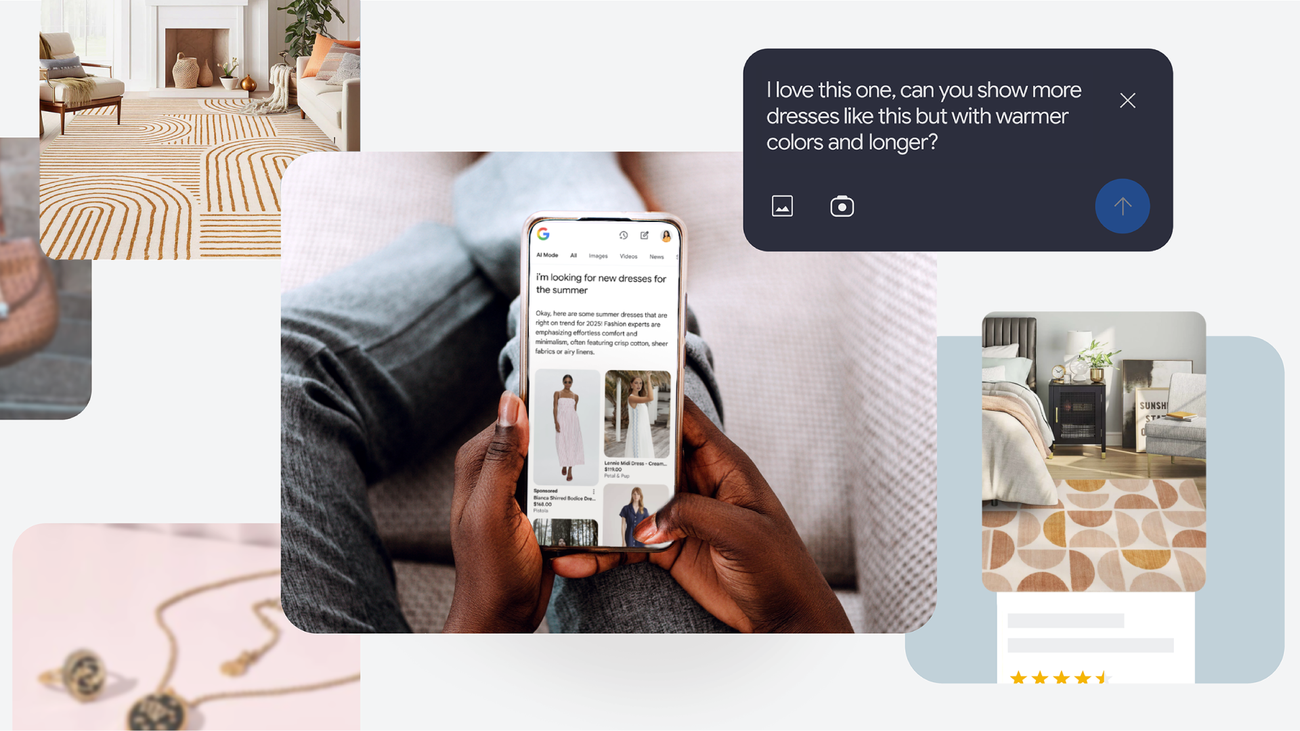
Image: Google’s official graphic for its AI Mode shopping experience, which has offered photo-based virtual try-on since May 2025. Credit: Google.
Why It Matters
Both companies are chasing the same prize: becoming the place people start — and finish — their shopping, instead of just a stop on the way to Amazon or a retailer’s site. That’s a meaningful shift. Search and chat assistants used to be for finding information; now they’re being built to close the loop on a purchase entirely.
The two approaches reveal different bets on how to get there. OpenAI is leaning on ChatGPT’s conversational strength — you’re already describing what you want in plain language, so visualizing it and remembering it feels like a natural extension. Google is leaning on its decade of shopping infrastructure: a Shopping Graph with more than 50 billion product listings, tight integration with Google Pay, and relationships with payment and logistics systems that make an actual “buy it for me” plausible. Different protocols underpin each: OpenAI’s Agentic Commerce Protocol (ACP) is built for discovery, while Google’s Universal Commerce Protocol (UCP) is built to give merchants more control over checkout itself.
Neither is purely altruistic. Fashion brands have real incentive to be visible inside both. An Adobe analysis cited by WWD found that AI-referred shoppers converted at a 54% higher rate in May 2026 than non-AI traffic — a complete reversal from a year earlier, when AI-referred visitors converted at roughly half the rate. That’s the real reason OpenAI and Google are racing to build this out: the traffic is starting to actually spend money.
What It Means for Everyday Shoppers
If you just want a gut check on whether an item will suit you before you buy, ChatGPT’s new Try On button is a quick, low-friction option, especially if you’re already chatting with it about what to buy. But because OpenAI hasn’t published details on how long it keeps your uploaded photos or whether they’re used to improve its models, it’s worth treating it the way you’d treat any photo upload to a chatbot — don’t use an image you wouldn’t want stored somewhere.
Google’s version has been refined over a longer period, supports more garment types, is clearer about its privacy handling, and — if you’re in one of the supported countries — can go a step further and actually complete the purchase for you once a price you set is hit. If you’re the kind of shopper who wants to “set and forget” a price target, that’s currently something only Google offers at any scale.
This is also part of a broader pattern worth watching: AI tools are moving from telling you things to doing things with your money and your accounts. We’ve written before about weighing trust and permissions when letting an AI agent act on your behalf — the same questions apply here. Before you hand either assistant your payment details, check what it’s authorized to do without asking you again.
What It Means for Online Sellers and Developers
For retailers, the practical path into ChatGPT’s shopping surface is through the Shopify Catalog integration or direct ACP participation — no extra work is required for merchants already on Shopify, per OpenAI’s own documentation. Getting into Google’s agentic checkout, by contrast, currently means being one of the participating US merchants under the Universal Commerce Protocol, with Canada, Australia and the UK coming later.
Developers building shopping or fashion-adjacent tools should note that OpenAI’s GPT Image 1.5/2.5 models are available via the API, so the same “try it on” editing capability ChatGPT uses is accessible to build into other products — it’s not exclusive to ChatGPT’s own interface.
A Fair Comparison, Not a Test Drive
To be clear: this is a comparison based on OpenAI’s, Google’s and Google Merchant Center’s own documentation and reporting from TechCrunch, WWD and Engadget — not a hands-on trial of both tools side by side. Treat the “accuracy” of either try-on result with some skepticism until you’ve tried it yourself; both companies explicitly warn that generated images can get body shapes, proportions or garment details wrong.
Choose ChatGPT’s Try On if: you’re already in a ChatGPT conversation figuring out what to buy, you want a fast visual sanity check, or you’re shopping for a specific “vibe” and want ChatGPT to assemble a look for you.
Choose Google’s virtual try-on if: you want a feature with a longer track record, support for more garment types, documented privacy handling, or you’re in a country and situation where Google’s agentic checkout can complete the purchase for you automatically.
What Happens Next
A few things are worth watching. OpenAI has not said whether it plans to bring agentic checkout back to ChatGPT after the Instant Checkout misstep, or whether it will publish clearer data-retention terms for try-on photos — both would materially change this comparison. On Google’s side, the Flipkart “Buy” button test in India is due to expand more broadly this month, and the agentic “buy for me” checkout is expected to reach Canada, Australia and the UK in the coming months. If either company adds shoe or accessory try-on, expands country coverage, or publishes new privacy terms, we’ll update this comparison.
Final Takeaway
ChatGPT’s new Try On and Favorites features are a solid, overdue addition for a chatbot that 900 million-plus weekly users already turn to for shopping advice. But “new” isn’t the same as “best”: Google has spent over a year refining a very similar idea and has already moved a step further, into actually finishing the purchase for some shoppers. If you’re choosing a tool based on which one gets you from “I wonder if this looks good on me” to “it’s in my closet” with the least friction, Google currently has the edge — for now, in the countries where it’s available. ChatGPT’s version is worth trying for the visual gut-check, just don’t expect it to close the sale for you yet.