
Claude Sonnet 5.5 Is Here: Near-Opus Results at Half the Price, Plus One New Behavior You Should Know About
- theDevXpert Team
- September 29, 2026
- No Comments
Image: Anthropic, official Claude Sonnet 5.5 announcement graphic (source).
Anthropic released Claude Sonnet 5.5 on September 28, 2026, six days after Claude Opus 5.5. It’s the mid-priced Claude model that many chat apps, coding tools and business bots run on. Anthropic says it’s 30% faster than Sonnet 5 and costs up to 30% less per task, with no change to the per-token price. On several of Anthropic’s own benchmarks it lands close to Opus 5.5, which costs twice as much per token. There’s also a behavior change that everyday users and developers should know about: for a narrow set of sensitive requests, Sonnet 5.5 can now hand your conversation back to the older Sonnet 5. Here’s what changed, what’s confirmed, and what to do about it.
What Happened?
Anthropic calls Sonnet 5.5 the second model in its Claude 5.5 family. Opus 5.5, released on September 22, is aimed at complex work that needs careful judgment. Sonnet 5.5 is pitched as the faster, cheaper partner for “well-scoped everyday tasks,” fixing bugs, and producing documents, slides and spreadsheets. A third model, Claude Haiku 5.5, is due “in the coming weeks,” according to the same announcement.
The launch reached other tools straight away. On the same day, GitHub announced that Claude Sonnet 5.5 is generally available in GitHub Copilot, with a gradual rollout across VS Code, JetBrains IDEs, Xcode, the Copilot CLI, github.com and GitHub Mobile.
If you followed our coverage of the GPT-6 Sol and Claude Opus 5.5 price war last week, this is the next step in that story. The competition is now about capability per dollar, and Sonnet is the tier where most real-world usage happens.
The Key Details
Price and speed
- Per-token price is unchanged: $2 per million input tokens and $10 per million output tokens, the same as Sonnet 5. Cache reads cost $0.20 per million tokens. Tokens are the small chunks of text that AI usage is billed by.
- Cheaper per task: Anthropic says Sonnet 5.5 needs far fewer tokens to do the same work, so it costs up to 30% less per task in its testing.
- Faster: output is generated more than 30% faster than Sonnet 5, making it Anthropic’s fastest Sonnet so far.
- Where to get it: the Claude apps and the Claude API (model ID
claude-sonnet-5-5), plus Amazon Bedrock, Google Cloud and Microsoft Foundry. Anthropic’s Sonnet page says anyone can chat with it on Claude.ai on the web, iOS and Android.
For context, the per-token price matches OpenAI’s GPT-6 Sol ($2/$10) and is half of Opus 5.5 ($4/$20).
How it compares (vendor-reported)
Every number below comes from Anthropic’s announcement. None has been independently verified yet, so treat them as the company’s own results.
| Benchmark (what it tests) | Sonnet 5.5 | Sonnet 5 | Opus 5.5 |
|---|---|---|---|
| Terminal-Bench 4.0 (agentic coding in a terminal) | 70.6% | 10.3% | 66.4% |
| CursorBench 4.0 (real multi-file coding tasks) | 55.5% | 34.1% | 57.8% |
| OSWorld 2.1 (operating a computer) | 80.1% | 57.0% | 81.8% |
| GDPval-AA v2.1 (real-world office work, Elo-style score) | 1844 | 1449 | 1846 |
Two caveats matter here. First, the huge jump on Terminal-Bench (10.3% to 70.6%) is unusual, and it’s the kind of result worth watching for independent confirmation. Second, Anthropic itself says benchmarks tell only part of the story: in its own testing and that of outside testers, Opus 5.5 “remains clearly stronger at complex, open-ended work requiring sustained judgment.” Sonnet 5.5 is near Opus on many scores, but it doesn’t replace Opus.
Early customer comments on the announcement page tell the same efficiency story. Slack reported about 14% fewer output tokens on its Slackbot tests without changing prompts. Zendesk said tickets were processed 20% faster. Lovable said its coding evaluations needed a third fewer tool calls. These are partner quotes published by Anthropic, not independent studies.
Default "effort" settings
“Effort” controls how long Claude thinks before answering. In the Claude apps and Claude Code, Sonnet 5.5 defaults to Medium effort. On the Claude Platform (the API), it defaults to High. Lower effort is faster and cheaper, while higher effort reasons longer and checks its work more carefully.
The New Behavior: Why Your Chat Might Switch Models
This is the part most launch coverage skims past, and it affects real users.
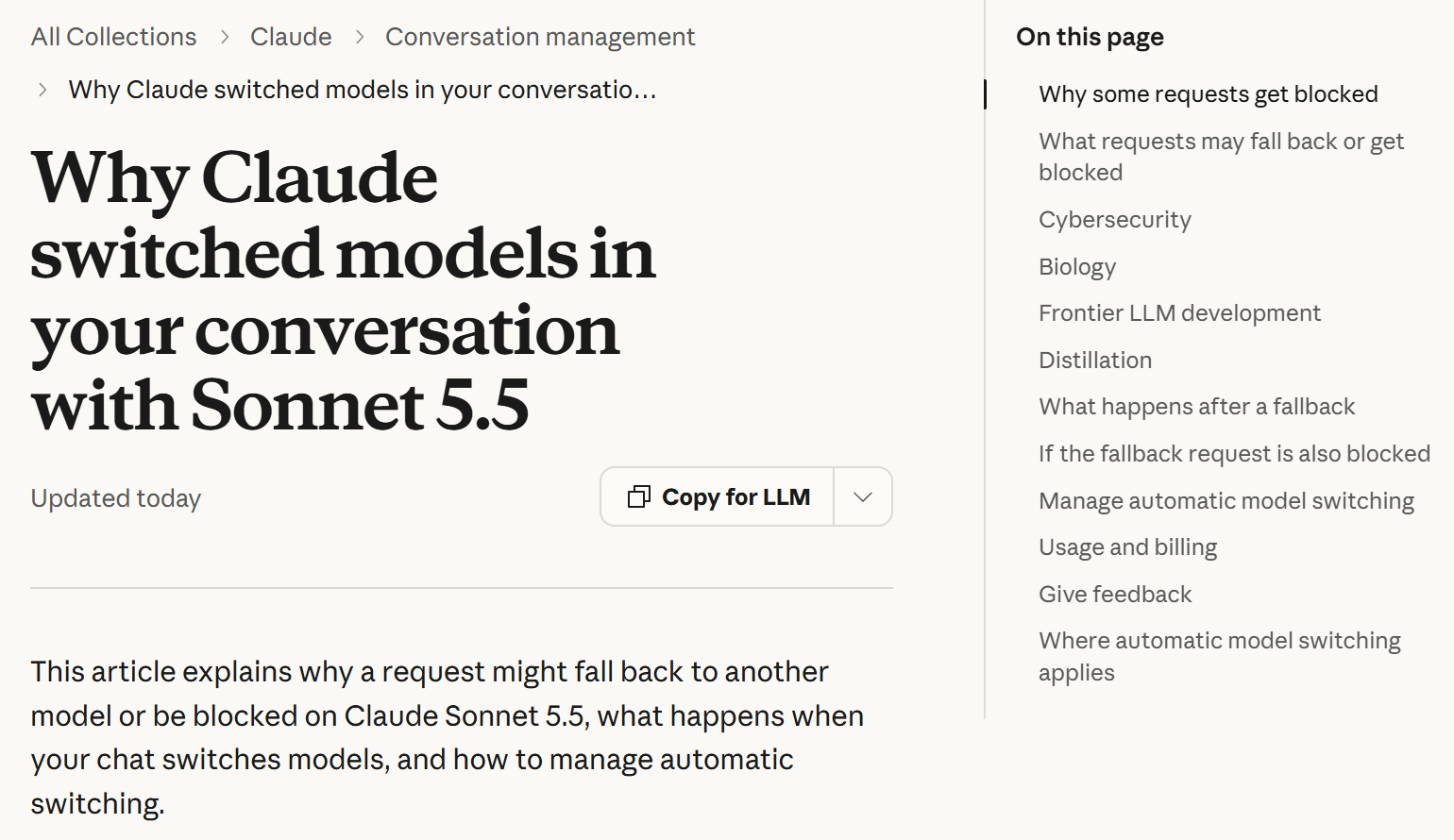
Image: Anthropic, screenshot of the official Claude Help Center article on Sonnet 5.5 model switching (source).
Anthropic says Sonnet 5.5’s cybersecurity skills are a large step up from Sonnet 5’s. So it’s the first Sonnet model to ship with the same kind of safeguards as the company’s top models. According to Anthropic’s help article on model switching, this is how it works:
- Most requests are unaffected. Routine coding, bug fixing and scanning your own source code for vulnerabilities stay on Sonnet 5.5.
- Some higher-risk requests fall back to Sonnet 5. Examples include exploit generation, binary vulnerability scanning and penetration testing, plus a small set of requests related to building the most advanced AI models. Claude re-runs the request on Sonnet 5, shows a notice, and labels the answer with the model that produced it.
- Some requests are blocked outright. Requests that could help cause serious biological harm, and attempts to make Claude reproduce its internal reasoning word for word, are blocked rather than switched. You can still ask Claude why it did something or to explain its thinking conversationally.
- Anything Claude reads can trigger it. The safety checks cover memory, connector content, web search results and files, not just what you typed.
- The switch sticks for that chat. After a fallback, the model picker stays on Sonnet 5 for the rest of the conversation. You can switch back, but the same request may trigger the fallback again. Editing the earlier message often helps.
How to control it: automatic switching is on by default. You can turn it off in Settings > Capabilities (or Config > MODEL & OUTPUT in Claude Code) by toggling off “Switch models when a message is flagged.” With it off, a flagged request pauses the chat instead, and you can edit and retry or choose another model.
Honest take: this is a reasonable trade-off, but it will occasionally confuse people. If your answer suddenly says “Sonnet 5” at the top, that’s why. Security professionals with legitimate needs will want to watch for Anthropic’s expanded Cyber Verification Program, which the company says is coming “soon.”
What It Means for Everyday Claude Users
- Expect faster replies at the same subscription price. Nothing in the announcement changes plan prices. Because Sonnet 5.5 uses fewer tokens per task, it’s reasonable to expect your usage allowance to go a bit further, though Anthropic hasn’t published new plan limits, so don’t count on specific numbers.
- Try it for “polished output” jobs. Anthropic highlights documents, slide decks and spreadsheets. In one internal test, two experts judged its first draft of a 10-slide operating review ready to send. A good first test for you: give it a template and ask for a short deck or a one-page summary. (This is a suggestion, not something we tested hands-on.)
- Keep Opus for the hard stuff. For long, ambiguous projects where judgment matters, like strategy memos, tricky debugging or research synthesis, Anthropic’s own guidance points to Opus 5.5.
- Know what the switch notice means. See the section above. It isn’t an error, and it doesn’t mean you did something wrong.
What It Means for Developers
Sonnet 5.5 isn’t a drop-in swap. Anthropic’s What’s new in Claude Sonnet 5.5 page lists five breaking changes for code already running on Sonnet 5. The ones most teams will hit:
thinking: {"type": "disabled"}now returns a 400 error. Use the newthinking: {"type": "between_tools"}setting instead. It only works at low, medium or high effort. At xhigh or max you need adaptive thinking.- Forced tool use is gone.
tool_choiceset toanyor a specific tool returns a 400 error. Useautowith strict tool use, or structured outputs, and say in the prompt when a tool should be used. - Thinking blocks are tied to the model, the conversation and the account. Keep conversations append-only: change instructions or tools with mid-conversation system messages rather than editing earlier history. Blocks sent from a different, unlinked account are dropped.
- Computer use on the Claude API and Google Cloud requires the newer
computer_toolset_20260801toolset. - Advisor-tool pairings changed. Opus 4.8, Opus 4.7 and Sonnet 5 advisors are rejected with a Sonnet 5.5 executor.
Two quieter changes are also worth knowing. Text Claude writes between tool calls now comes back inside thinking blocks, so an app that streams those notes to users can go silent unless you set a display option. And refusals come back as HTTP 200 with stop_reason: "refusal" plus a category (cyber, bio, frontier_llm, reasoning_extraction or general_harms). On the API, automatic fallback isn’t on by default, so you need to handle refusals or configure fallbacks yourself.
A sensible rollout plan: change the model ID in a staging branch, fix the 400 errors above, then rerun your effort settings. Anthropic says effort levels were recalibrated, so a setting carried over from Sonnet 5 won’t behave the same. Compare cost per completed task, not cost per token. That’s where the promised savings would show up. The full migration guide has before-and-after code.
Image: GitHub, official changelog graphic for Claude Sonnet 5.5 in GitHub Copilot (source).
If you use GitHub Copilot: GitHub says Sonnet 5.5 is available on Copilot Pro, Pro+, Max, Business and Enterprise, billed at provider list pricing under usage-based billing. Admins on Business and Enterprise plans can manage it through the Copilot model policy. New models are enabled automatically unless an admin has turned that off, so check your policy if you want control over which models your team uses.
What It Means for Businesses
For companies running customer support bots, document pipelines or internal assistants on Sonnet, this is mostly good news: same price per token, fewer tokens per task and faster responses. Anthropic also says Sonnet 5.5 is available with zero data retention, which matters for regulated industries.
The practical questions are operational:
- Budget: run a small A/B test on real traffic and measure cost per resolved ticket or per finished document. Vendor “up to 30%” figures are best cases.
- Reliability: update error handling for the new refusal categories before you switch production traffic.
- Governance: decide whether automatic model switching should be on for your staff, and document why a response might come from Sonnet 5.
If your team needs help planning a model migration or building an AI assistant that handles these edge cases properly, that’s the kind of work our AI solutions and automation team does.
What Happens Next?
- Claude Haiku 5.5 is confirmed for “the coming weeks.” It’s the cheapest tier and will matter for high-volume apps.
- Independent benchmarks from groups such as Artificial Analysis should confirm or complicate Anthropic’s numbers. Anthropic notes that Artificial Analysis already ran two of its knowledge-work tests on a pre-release version that had a since-fixed bug.
- OpenAI’s DevDay takes place on September 29 in San Francisco. OpenAI hasn’t confirmed what it will announce, so any response to Sonnet 5.5 is speculation for now.
- Google’s Gemini 4 is, in Google’s words, coming “as soon as possible,” but there’s no date yet.
Final Takeaway
Claude Sonnet 5.5 is a practical upgrade rather than a flashy one. It keeps Sonnet’s price and, by Anthropic’s own measurements, gets much closer to Opus quality while using fewer tokens and finishing faster. For everyday users, the main thing to learn is the new model-switch notice and the setting that controls it. For developers, budget an afternoon for the breaking changes before you flip the model ID. Then measure cost per finished task yourself, because that’s where this release has to prove its claims.
Sources: Anthropic: Introducing Claude Sonnet 5.5 · Claude Help Center: model switching with Sonnet 5.5 · Claude Platform Docs: What’s new in Claude Sonnet 5.5 · GitHub Changelog · TechCrunch. Full list in sources.md.